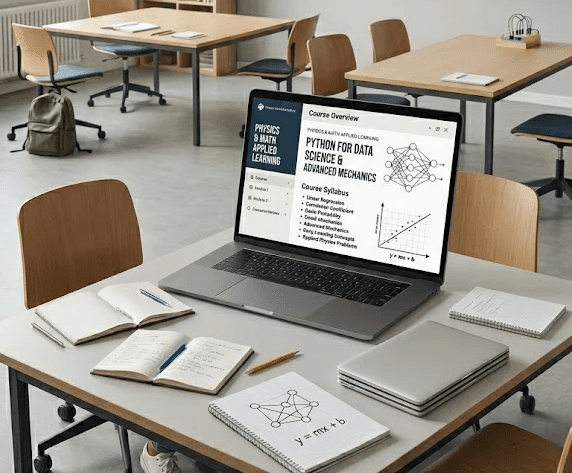
AI Curriculum Development for Physcis & Math Faculty at KPI
AI Curriculum
Project Background
To better align the traditional Mathematics and Physics curriculum with modern industry and research needs, we designed a set of hands-on AI laboratories that connect core theoretical concepts with real-world problem solving. While Master’s-level courses provide strong fundamentals, students increasingly need practical experience applying computational methods and AI tools to complex, data-driven challenges.
In response, we developed 10 applied AI labs that introduce students to modern AI-powered approaches for modeling, analysis, and decision-making in real scenarios grounded in Math and Physics. The labs focus on building practical skills: framing problems, working with data, selecting appropriate methods, and validating results using contemporary tools.
Due to their strong educational impact and relevance, the AI labs were adopted as a required component across three Master’s courses, strengthening the curriculum with applied learning and industry-ready competencies.
Developed 10 AI laboratory works for Physics, Math, and other technical studies students. Each laboratory includes theory, a practical part such as implementation of neural nets and other AI models, and validators that allow for automatic checking of the lab without human resources.
Objectives
Integrate AI into the curriculum: Seamlessly embed hands-on AI labs into three Master’s courses to complement core Math and Physics theory.
Transform theory into practice: Enable students to solve real-world problems using modern AI tools and computational methods.
Standardize and scale lab delivery: Develop a consistent, reusable framework for labs that can be taught effectively across cohorts and instructors.
Foster applied learning and evaluation skills: Teach students structured workflows for problem-solving, experimentation, and solution assessment.
Iteratively refine content: Pilot labs, collect feedback, and improve materials to maximize learning outcomes and engagement.
Key Features Delivered
Hands-on, practical focus: Students actively apply AI tools to solve real-world Math and Physics problems.
Integration with core curriculum: Labs complement and reinforce concepts from three Master’s courses.
Structured, repeatable lab framework: Each lab follows a clear workflow: problem → data → method → implementation → evaluation → reflection.
Modern AI and computational tools: Includes exposure to current AI libraries, frameworks, and data analysis techniques.
Step-by-step guidance with autonomy: Combines instructional support with opportunities for independent problem solving.
Assessment and feedback mechanisms: Clear criteria for evaluating student solutions and iterative improvement.
Reusability and scalability: Labs are designed to be consistently taught across multiple cohorts and instructors.
Real-world problem orientation: Focused on challenges relevant to research, engineering, and industry applications.
Our Approach
Curriculum Mapping: Analyzed the learning outcomes of three Master’s courses in Math and Physics to identify where AI labs could reinforce theoretical concepts.
Lab Design & Development: Created 10 hands-on AI labs, each structured around a real-world problem, relevant datasets, and a step-by-step workflow (problem definition → method selection → implementation → evaluation → reflection).
Tool Integration: Incorporated modern AI and computational tools (Python, ML libraries, data analysis frameworks) to ensure students gain practical, industry-relevant experience.
Pilot & Feedback Iteration: Conducted initial trials with student cohorts, collected feedback on clarity, difficulty, and engagement, and refined labs to optimize learning outcomes.
Curriculum Integration: Embedded the labs as a required component in the three Master’s courses, aligning scheduling, assessments, and grading with existing course structures.
Results
Curriculum Enhancement: The AI labs became a mandatory part of three Master’s courses, bridging the gap between theory and practice.
Improved Student Competencies: Students developed hands-on skills in AI, computational modeling, and problem-solving applied to Math and Physics challenges.
Practical Exposure: Students gained experience with real datasets and industry-relevant AI workflows.
Standardized Learning Resources: Labs were delivered with complete materials (instructions, code templates, datasets, and rubrics), ensuring consistency across cohorts and instructors.
Positive Feedback & Engagement: Pilot sessions demonstrated high engagement, improved confidence in AI techniques, and better preparedness for research or industry applications.
Prev Project
Next Project